
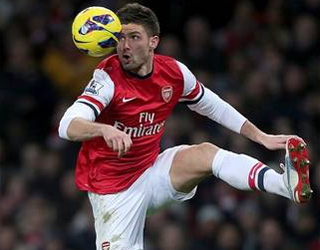
The conventional target man would be used to get the ball directly into either the most or just before the most attacking phase in football. A knock down to a team mate and a team could launch an attack from there, the typical target man was also generally a team’s top scorer and someone the team could rely upon to score goals. With this new style of a creative target man this element of football still exists for them in terms of knocking the ball down for team mates and making for an easy transition from defending to attacking. The burden of scoring much of the teams goals however has very much been lifted from them. They are required to contribute more to the actual attack of the team than just possession retention, usually done by utilising three skills that are very
As the season starts to head into the home straight, the race for the two Champions League places is still wide open. Games start to come thick and fast from here on in, and it’s during these times that a team needs to be most composed and effective. Football however is not only fast paced in its physicality but also in its expansion and evolution, things that worked before become outdated and predictable, roles are remodelled and fans expectations follow suit. For example no longer is it acceptable for a defensive midfielder to just get the ball, it must be retained, it must be won high up and it must be played well. The revolution sparked by one Sergio Busquets has very much happened though, it’s the redevelopment of another role, sparked by a player much closer to home, that is making for an interesting watch. The flowering of the creative target man.
The conventional target man would be used to get the ball directly into either the most or just before the most attacking phase in football. A knock down to a team mate and a team could launch an attack from there, the typical target man was also generally a team’s top scorer and someone the team could rely upon to score goals. With this new style of a creative target man this element of football still exists for them in terms of knocking the ball down for team mates and making for an easy transition from defending to attacking. The burden of scoring much of the teams goals however has very much been lifted from them. They are required to contribute more to the actual attack of the team than just possession retention, usually done by utilising three skills that are very much underrated and often wreak havoc. Positioning, work rate and movement.
One of the hardest things for a defensive players to do is to judge a situation in which nobody poses an immediate threat to the goal in a typical counter attacking situation;
As the striker is the immediate and largely the only threat present in this situation [image below], the defender is now presented with two opportunities, close him down and pressure him in order to win the ball back high up and resume the teams attack or stand off and allow recovering team mates to win the ball back. The latter is the option most defenders take, partially influenced by the fact that at this point in time it’s just the target man taking on up to four defensive players alone. Generally they’re not too fast and are not going to run away from you.
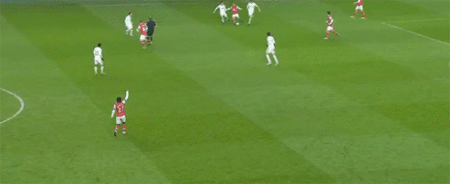
[Olivier Giroud is the furthest Arsenal player forward and is about to receive a pass from the player who currently has the ball, Santiago Cazorla.]
When the defender stands off however this creates space for wingers, midfield runners and other team mates to go bombing forward and exploit the space. Defenders are now presented with two more opportunities, follow the run and create space for the target man to play. Pick a pass or if he deems the support insufficient he can revert to his tradition role and retain the ball allowing other team mates to move further up the pitch and to allow his teammates to build an attack from there
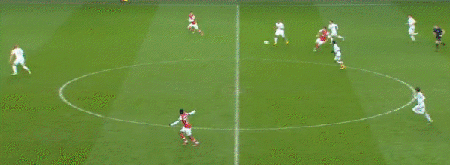
[In this case Swansea are already 1-0 down and there isn’t much time left on the clock, a combination of defenders and midfielders try to press Olivier Giroud and win the ball high up, Giroud beats them with a clever touch and in turn has two runners in support with only one Swansea defender back. He plays the ball into Aaron Ramsey who after advancing onto goal plays in Gervinho who rounds of the attack with a goal.]
Playing with a creative target man is generally a new concept and whilst it may have been done in a smaller scale it is yet to hit the mainstream in world football. In recent years the creative target man has not only enabled teams to reach new heights but it’s also made for decent footballing teams. From Athletic Bilbao reaching the Europa League semi-final from nowhere with Fernando Llorente and beating the likes of Manchester United. Borussia Dortmund securing their third back to back titles and inflicting a straight 5th defeat against Bayern Munich in the final with Robert Lewandowski who made Shinji Kagawa look very much better than he is. Borussia Monchengladbach a team that barely survived relegation the season before reaching 4th in the Bundesliga, a Champions League spot, with Mike Hanke who at times found 3 or 4 players in front of him when his team scored a goal.
Hanke also allowed Marco Reus to rise to fame, allowed Reus to play ‘The Rotating Pivot’ well as he played deep, won the headers, linked up with the midfielders and well. This season, Arsenal have adopted this style of play with Frenchman Olivier Giroud. Divides opinion amongst the Arsenal faithful but when Olivier Giroud is playing up front for Arsenal you know that something is going to happen. What Giroud lacks in technical ability and experience he makes up for in movement and endeavour and he allows the Arsenal team to deploy the creative target man with frightening expertise.
Follow @Suldanki on Twitter
EXAMPLE OF AD POSITION
