

As you can see, Walcott and Chamberlain find themselves quite some way behind the pace with minute totals above the average of the nine in all four categories. Walcott creates a chance only once every 67 minutes, more than double the time it takes Antonio Valencia, Nani or Silva to do likewise. It’s a similar story with minutes per assist, and I’m afraid Theo favours even worse even when it comes to
A statistical analysis by Benjamin Cullen @benvenceremos
‘Is it back to flight-school for some of the Arsenal wing-men?’
Arséne Wenger recently remarked “It is difficult for us because the wages in some other clubs are very high.
But, of course, our players quite rightly compare themselves to the players of the other clubs.”
I think the vast majority of us took this to be a thinly-veiled comment on the contract situations of either Robin van Persie or Theo Walcott, or both even.
But, whereas there can be little argument, statistical or otherwise, about whether Robin van Persie can count himself to be in the very top bracket of players in his position. Can the same be said of Theo Walcott and the other Arsenal wingers, for that matter? (new signings not included) Are they really comparable to the top wide-men in the league?
To find that out, I’ve taken the statistics of David Silva, Antonio Valencia, Ashley Young, Nani, Juan Mata and Gareth Bale- arguably the top six wide-midfielder/forwards from Arsenal’s ‘top 6’ rivals- and compared them with those of the three most prominent Arsenal widemen of the 2011-12 season: namely Theo Walcott, Gervinho and Alex Oxelade Chamberlain.
On first glance, it’s Theo Walcott who seems to be the stand-out man for Arsenal; certainly his 8 goals and 8 assists in 2011/12 place him in the top five for both categories among wide-midfielders across the league.
However, Theo Walcott played 2747 minutes last season, nearly double the 1685 minutes Gervinho managed and around about 5 times more than Chamberlain’s 556. So to more fairly assess each player’s contribution, it’s perhaps better to assess the players by their minutes per action statistics.
Let’s do that then, and what better place to start than by looking at minutes per attacking action stats. I’ve chosen four statistics to analyse here: minutes per chance created, minutes per ‘clear-cut’chance created, minutes per assist and, lastly, minutes per accurate cross.
Below we have the results of the nine players in question, as well as (on the far right) the average score of the nine players studied. Remember the statistics here are ‘minutes per attacking action’, so for this bar chart, rather like limbo or hobbit drinking holes: the lower the bar the better.
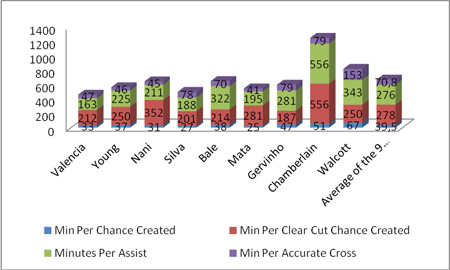
As you can see, Walcott and Chamberlain find themselves quite some way behind the pace with minute totals above the average of the nine in all four categories. Walcott creates a chance only once every 67 minutes, more than double the time it takes Antonio Valencia, Nani or Silva to do likewise. It’s a similar story with minutes per assist, and I’m afraid Theo favours even worse even when it comes to minutes per accurate cross: taking more than 3 times the time to produce an accurate cross than any of his United counterparts.
Of the Arsenal men, perhaps surprisingly for many Arsenal fans (who many have been more than a little critical of) only Gervinho’s statistical profile is better than the average of the nine players. He is, in fact, the standout performer in terms of minutes per clear-cut chance created, and overall, he comes in at a respectable 5th beating Bale, Nani and his two Arsenal colleagues.
What might worry Arséne Wenger, and has perhaps already forced him into action in this area (with at least two of his summer signings, in Cazorla & Podolski, being strong candidates for those wide positions) is the vast chasm that can be seen between the performance level of his wide men and that of the two Manchester clubs that stood between Arsenal and the title in 2011/12.
In the below chart we can see the sum of Arsenal’s attacking actions per minute (in red) compared with the average of the nine players (in green), and those of the 4 selected Manchester players in blue.
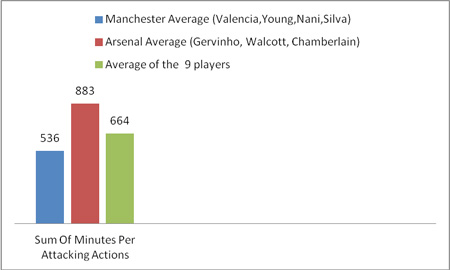
The Manchester wide men, it seems, took almost 40% less time to perform one of the key attacking actions than the Arsenal wingers did.
However, another way with which attacking performance might be measured, without taking into consideration minutes played, is by assessing the percentages with which players successfully execute certain key actions. So let’s have a look at how the players fared for crossing, passing, shooting accuracy and chance conversion, shall we? Remember this time the scores are percentages, so like pole-vault or recording Rolling Stones’ albums, the higher the better here:
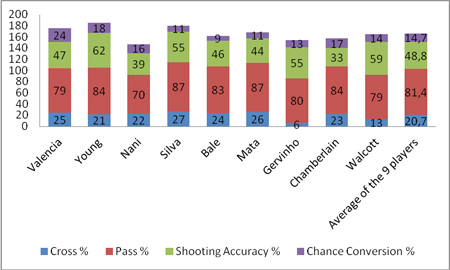
Unfortunately for the Arsenal men, the picture from the percentage perspective doesn’t look much better for them. In fact, none of the three players reach even the average overall level of the nine (although Walcott is just fractions away from it admittedly). Walcott and Gervinho especially, suffer from very poor crossing percentages, something Chamberlain on the other hand does much better at, with a 23 percent success rate, far more in keeping with the levels set by the other rival widemen.
Perhaps unsurprisingly, all three Arsenal players do score above average on pass percentages, however. And again, Chamberlain is the best of the Arsenal lads with 84 percent success rate: the second highest score overall. However, the reverse is true for shooting accuracy. Walcott and Gervinho actually have the second and third best percentages for shooting accuracy on 59 & 55 percent, whereas Chamberlain has perhaps succumb too often to the temptation for a long-range blast, as his accuracy is far lower at 33 percent.
Predictably, though, Gervinho and Theo then fall down somewhat on chance conversion, with 13 & 14 percent respectively. While Chamberlain is again the best of the Arsenal bunch in this category with an above average 17% conversion rate behind only Valencia and Young. So encouragingly for young Alex, with a bit of work on his shooting accuracy he could soon hold his head high in such esteemed company, because in passing, crossing and chance conversion he scores quite a bit higher than the average for the widemen in question.
So how do Arsenal compare with their two higher placed rivals in the percentages game?
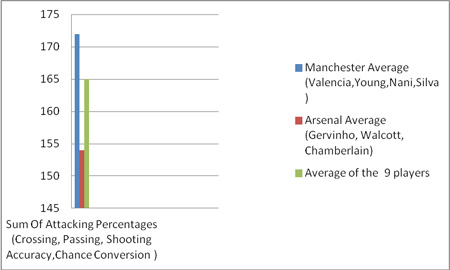
Again, poorly really. The average sum of the Manchester players’ percentages is almost 20 percent higher than that of their Arsenal counterparts.
But attacking, of course, is just one side of the game and any analysis of the players’ performance would be incomplete if we didn’t also address the defensive side of the game. So, using a minutes p
er action method once more, let’s assess the wingmen’s defensive contribution. I probably don’t need to remind you now that with this chart being minutes per action it means the the tighter (or lower) the bar, the tighter the defence of the player in question.
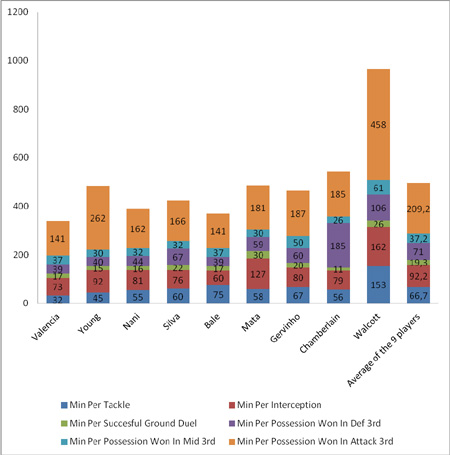
The bad news for Arséne Wenger, and perhaps more so for the full-backs at the club, is that again only Gervinho’s performance can be seen to be better than the average level of the nine players. He beats Young and Mata too to take fifth best overall defensive performance of the nine players, helped by better than average scores at minutes per interception, and minutes per possession won in the defensive and attacking thirds.
Chamberlain also beat the average on minutes per tackle and interception, as well as minutes per successful ground duel and minutes per possession won in the midfield third, but his overall score is tarnished somewhat by very poor scores in minutes per possession won in the defensive and attacking third. Something which is perhaps not so important if, as is seemingly the case for him, he is winning the ball in midfield instead.
It is in defensive contribution, however, that we most clearly see indications that Theo Walcott is more of a forward or striker by nature than a midfield player. Because he falls well behind the other eight wide-men in all six of the defensive areas. According to the results, for every tackle he puts in, Antonio Valencia makes nearly five. For every interception he makes, most of the others make 2. Worse still, his minutes per possession won in all three of the areas is far poorer than that of his counterparts, none more so than in possession won in the attacking third; where leaders, Bale and Valencia win more than three times the possession that Theo does.
When we look at how the Arsenal players compare with their higher placed Manchester counterparts, we begin to understand why Arsenal last season conceded 20 more goals than City, and 16 more than the injury plagued United defence did.
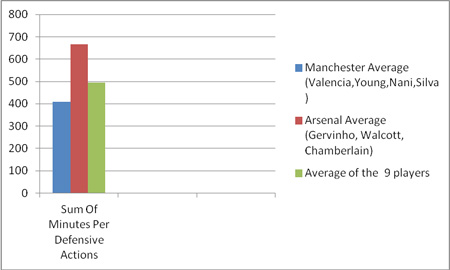
Because, as the bar chart above clearly shows: per minute on the pitch, the Manchester wide men are just so much the busier defensively.
So what conclusions can be drawn from this? Well, as I suggested earlier, perhaps Arséne has already made his conclusions and acted upon them by reinforcing his wide options with Cazorla and Podolski. But outside of upgrading the players themselves, the good news for Arséne Wenger and Arsenal fans is that; well first of all; all three players are younger than their Manchester rivals (The average age of the Manchester wide-men being 26.5 compared to Arsenal’s 22.3), much younger in the case of Theo and Oxelade-Chamberlain.
Secondly, in Gervinho- in terms of attacking and defensive actions per minute at least- they do seem to have a wide-man who could count himself amongst the top five in the league. However, he’ll probably need to improve his cross and chance conversion percentages this season if he’s to convince the fans to think of him in those terms.
What’s more, Chamberlain- another player experiencing his first Premier League campaign last year- also showed positive signs that he could well develop into a top wide-midfielder. Bar shooting accuracy, his percentages are very high and his good defensive work is also a strong hint at why he was preferred to Walcott by Roy Hodgson, a naturally ‘safety first’ football manager, when it came to England starts at the European Championships.
Walcott’s statistics on the other hand, show just what a defensive burden was placed on the Arsenal right full-back position last season, and with that in mind, it’s perhaps no wonder the team struggled so badly during those four or five full-backless fixtures in January. Perhaps playing Theo as a forward rather than a winger would be better suited to his abilities afterall (although he would need to better his chance conversion percentages you’d feel). Or perhaps he just needs to put more effort in to the defensive side of the game?
Either way, when it comes to any upcoming contract negotiations, if Theo is to ‘quite rightly compare himself with the players of other clubs’ as Arséne Wenger suggests. Well, wage-wise, I’m afraid he’ll probably have to look outside of the upper echelon set by the Valencia’s, Nani’s, Mata’s, and Silva’s of this league. Because statistically speaking, he’s still got someway to go before reaching their level.
Stats mostly taken from @jamesamey316‘s http://www.eplindex.com/16652/premier-league-wide-midfielders-20112012-stats-comparison.html
EXAMPLE OF AD POSITION
